Engineered Diffusers


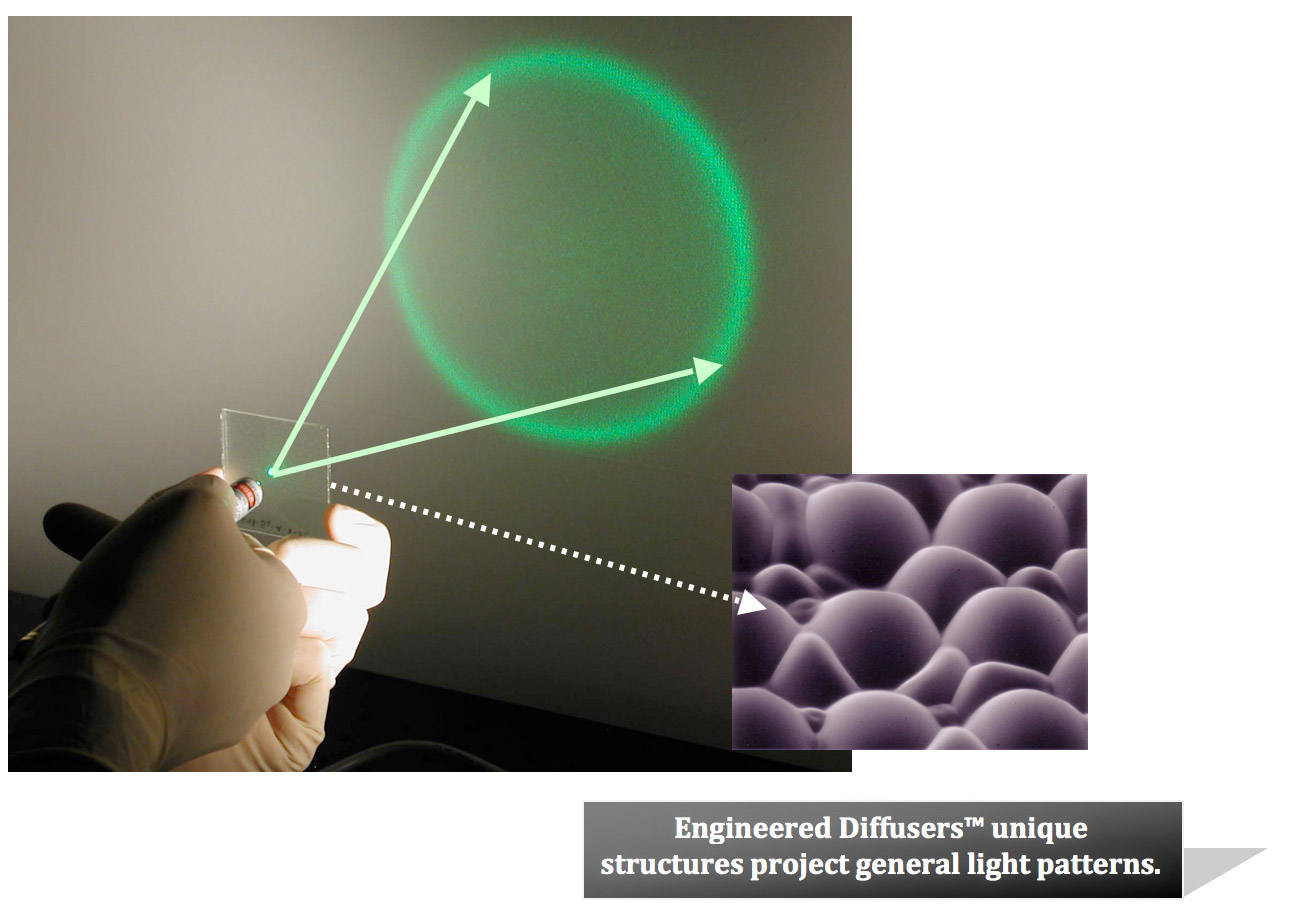
Engineered Diffusers™ represent a revolutionary concept in diffuser technology.

In the past, whenever a diffuser was needed the common choices were ground glass or holographic diffusers. In some specialized applications one might think of diffractive diffusers.

Here are the problems with these solutions:
  • Ground glass/holographic diffusers → Gaussian scatter only
  • Diffractive diffusers → Small angles, coherent illumination
  • Monochromatic illumination zero order
The introduction of Engineered Diffusers™ by RPC Photonics completely changed the picture and greatly expanded the realm of possibilities for diffuser technology.

Here is a taste of what Engineered Diffusers™ can do:
  • Homogenize non-uniform illumination
  • Spread light with specified divergence angle, narrow or wide
  • Control the intensity profile of the diffuse light
  • Control the way light is distributed in space

Homogenize non-uniform illumination

One of the most basic functions of a diffuser is to homogenize non-uniform illumination.

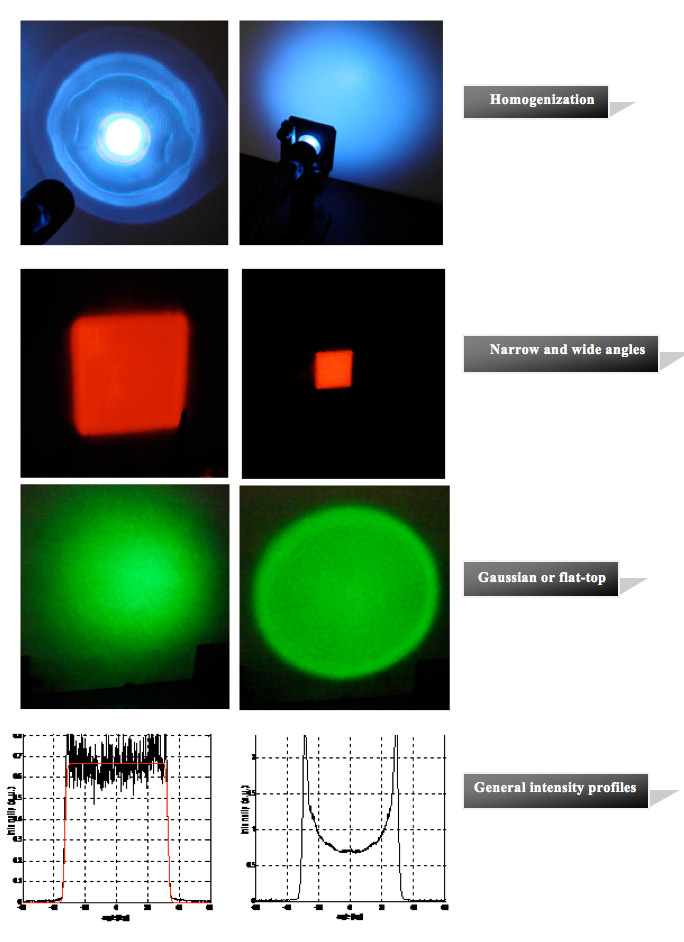
Here is the case of an LED source, notorious for producing non-uniform light distribution and the same LED with an Engineered Diffuser™.


The Engineered Diffuser™ eliminates the non-uniformity in the LED source producing a uniform distribution of light.


Spread light with specified divergence angle, narrow or wide


An Engineered Diffuser™ can produce diffuser light with specified divergence angles, narrow or wide.

Our mastering and production processes ensure tight tolerances in maintaining angle specifications from part to part.


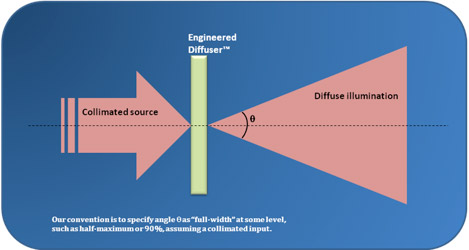
Our Convention is to specify angles as "full-width" at some level, such as half-max or 90%, assuming collimated illumination.


Here is the example of the measured scatter pattern for a 100-degree uniform circular diffuser from a diffuser with index of refraction n = 1.56


On the other extreme, here is a measured cross-section from the scatter of a 1/4-degree square diffuser (also index n = 1.56)

The scatter was measured with a coherent source at 633nm. The red curve provides a fit for the uniform region of the scatter.


Control the intensity profile of the diffuse light


Intensity control is a capability that common diffusers cannot generally provide while Engineered Diffusers™ truly excel.

In addition to homogenization and well-defined divergence angles, Engineered Diffusers™ distribute light according to your prescribed intensity requirements.

Uniform intensity distribution is a common specification.


Measured scatter from Engineered Diffusers designed to produce uniform scatter over 4 degrees.

Source laser, 633nm
Index of Refraction of diffuser: 1.56


This next example shows the scatter from an Engineered Diffuser™ designed to produce a batwing distribution where the intensity increases towards the edge.


Source laser, 633nm
Index of Refraction of diffuser: 1.61


This next example shows the scatter from a custom Engineered Diffuser™ designed to produce an intensity profile of the form


Source laser, 633nm
Index of Refraction of diffuser: 1.56


This next example shows the measured scatter from an Engineered Diffuser™ designed to produce a Gaussian distribution.


Source laser, 633m,
Index of refraction of diffuser: 1.61


Injection-molded Gaussian diffuser
Source laser, 633nm
Index of refraction of diffuser: 1.53


Here is Lambertian scatter produced by Engineered Diffusers™.


HILAM diffuser
Source laser, 633nm
Index of refraction of diffuser: 1.56


Control the way light is distributed in space

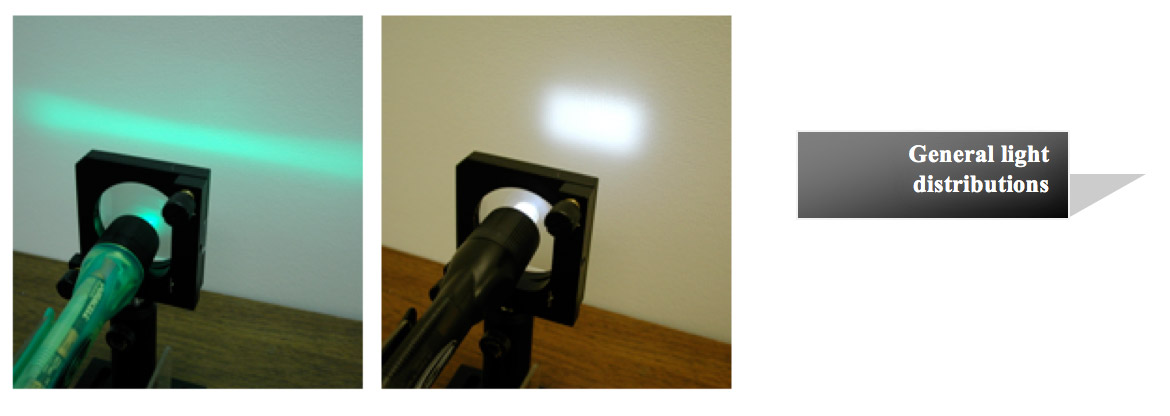
Another unique capability of Engineered Diffusers™ is the arbitrary distribution of light in space. Instead of being sprayed everywhere, light can be directed to certain portions of space to maximize efficiency, reduce light pollution, and/or create lighting effects.

Simple examples include square, rectangular, annular distributions, uniform circle, cross-hairs.


However, fairly general distributions are possible…


The point is that our Engineered Diffusers™ are not the common diffusers found elsewhere.

Engineered Diffusers™ are true beam shapers capable of homogenizing light, shaping its intensity profile and distribution in space.

No doubt, one of the most significant features of Engineered Diffusers™ is their ability to scatter light with uniform intensity distribution.

A plot we happen to love is shown below and demonstrates the ability of Engineered Diffusers™ to produce scatter with high uniformity.


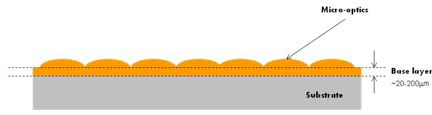
Engineered Diffusers™ are made of a large number of microstructures, such as microlenses, each one individually designed to produce a specific pattern of light.


To manufacture Engineered Diffusers™ we utilize our patented laserwriting process that is capable of producing deep analog surface structures with lithographic precision.

Our Engineered Diffusers™ can be shipped in various formats:
  1. Replicated polymer on a glass substrate
    This is a very cost-effective route for quick prototyping and/or low volume production
  1. Injection-molded plastic components
    For large volume applications we can injection-mold Engineered Diffusers™
    Some of our injection-molded diffusers can be purchased directly from ThorLabs
  1. Hard materials such as fused silica, silicon, or calcium fluoride
    We can also etch Engineered Diffusers™ into hard substrates

Engineered Diffusers™ - General Specifications*

  Polymer-on-glass Injection-molded polymers
Fused silica
Size Up to ~9×9 inches
Up to ~5×5 inches
Up to ~9×9 inches
Diffuser angles (full –width at 90%)
Up to ~120° Up to ~80°
Up to ~40°
Transmission efficiency (without AR-coating)
80% to 92%
80% to 92%
~92%
Transmission spectrum
350-3000nm
400-1400nm
180-2500nm
Uniformity (for flat-top diffusers)
±5-10%
±5-10%
±5-10%
Operational temperature range
-150°C to 120°C
~100°C max
~1000°C max
Water absorption
0.16%
< 0.01%
0%
Laser damage threshold
20J/cm2 @ 1054nm, 1ns pulse
Low
High
Cleaning
Blow dry air or nitrogen

*Specifications are for informative purposes only
Exact specifications depend on the specific material used and operating conditions.


Copyright © 2007 - 2008 RPC Photonics.  All rights reserved. 
Web design and hosting by BizNetix.